What Is an Industrial Motherboard and How Does It Work?
An Industrial Motherboard is the control foundation inside factory machines, automation cabinets, medical equipment, and transportation systems. Unlike a consumer motherboard, it is designed for long service cycles, stable operation, and harsh environments. It may support wide temperature ranges, vibration resistance, multiple serial ports, PCIe expansion, and remote monitoring. Some models also provide dual Ethernet, GPIO interfaces, and watchdog timers for fault recovery. These details matter when a production line cannot stop safely.
Industry demand is measurable. The International Federation of Robotics reported 541,302 industrial robot installations worldwide in 2023 in its World Robotics 2024 report. Every robotic cell requires dependable computing for motion commands, sensor processing, communication, and diagnostics. The World Semiconductor Trade Statistics forecast continued semiconductor market growth through 2025, reinforcing the need for reliable embedded platforms. However, more devices do not automatically create better systems. Poor thermal design, outdated firmware, or incompatible expansion cards can still cause expensive downtime.
How does the board work? The processor runs the operating system and control software. Memory stores active instructions and sensor data. Chipsets coordinate storage, networking, display output, and industrial interfaces. A watchdog timer can restart the system when software stops responding. The board then exchanges data with PLCs, cameras, drives, and cloud gateways. This process happens continuously, often inside a sealed cabinet beside motors and switching equipment. The exact architecture depends on workload, operating temperature, certification requirements, and expected service life. Reports from IDC and ARC Advisory Group consistently highlight edge processing, cybersecurity, and lifecycle support as industrial priorities. Yet vendor claims require careful verification. Testing under real vibration, heat, and network conditions remains essential.
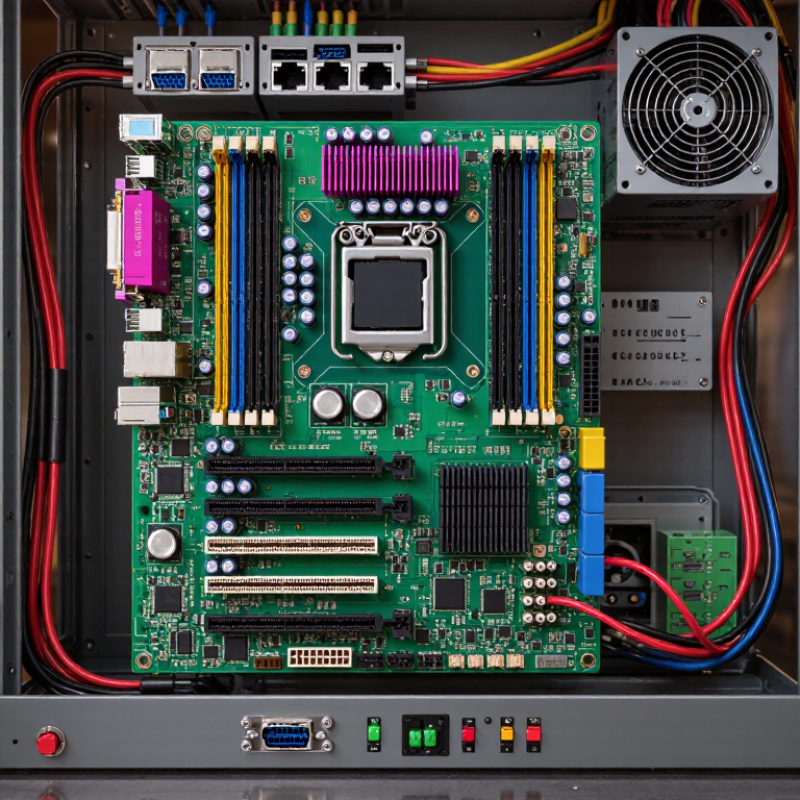
Industrial Motherboard Definition: Purpose, Architecture, and 7–15-Year Lifecycle
An industrial motherboard is the control platform inside equipment that must operate for years. It connects the processor, memory, storage, network ports, expansion cards, and field interfaces. Unlike a consumer board, it is designed for stable supply, vibration, dust, heat, and controlled component changes. Its purpose is continuity, not maximum speed.
Its architecture usually combines a long-life processor, industrial memory, watchdog circuitry, secure boot, and multiple serial, Ethernet, or GPIO interfaces. Heat sinks often replace small fans. That reduces one common failure point. The 2024 World Semiconductor Trade Statistics forecast valued global semiconductor sales at 588.4 billion dollars, showing why component availability deserves careful planning. However, strong market growth does not guarantee that every chip remains available. This is where platform control matters.
A realistic industrial motherboard lifecycle is seven to fifteen years. The first phase covers validation and deployment. The middle phase requires BIOS maintenance, thermal checks, and replacement-stock planning. The final phase may involve a compatible redesign. A 2023 industrial automation survey by an independent market research group found that more than half of surveyed manufacturers ranked long-term support among their top purchasing factors. The exact percentage varies by region and equipment type. That limitation matters. Engineers should request written availability periods, revision control, and change notices. A ten-year promise means little without documentation. Field testing is still necessary. Shelves can be cold, dusty, and unforgiving.
Industrial Motherboard Lifecycle: Typical Duration by Phase
Industrial motherboards are designed for long-term deployment in automation, transportation, medical, energy, and other embedded systems. A typical lifecycle spans approximately 7–15 years, including qualification, production availability, extended support, and final replacement planning. Actual durations vary by processor availability, component sourcing, environmental requirements, and system design.
Core Components: CPU, Chipset, RAM, Storage, and Industrial I/O
An industrial motherboard is the control center of equipment used in factories, transport systems, and outdoor cabinets. Unlike a consumer board, it is designed for long service, stable operation, and demanding environments. I have seen such systems run continuously beside motors, fans, and dusty production lines. That experience shows why component selection matters more than peak speed.
The CPU processes instructions from sensors, software, and connected machines. The chipset manages communication between the processor, memory, storage, and expansion interfaces. RAM holds active data, so sufficient capacity helps control programs respond without pauses. Industrial storage usually relies on solid-state technology because it tolerates vibration better than moving disks. Still, storage can wear out. Engineers should monitor write activity and keep replacement plans ready.
Industrial I/O connects the board to the physical world. Serial ports, digital inputs, digital outputs, network interfaces, and display connections support equipment such as barcode readers, relays, cameras, and human-machine panels. Isolation and surge protection can reduce damage from electrical noise. However, protection is never perfect. Grounding, cable routing, and enclosure design remain essential. A powerful CPU cannot correct poor wiring. During testing, technicians should check temperature, boot recovery, connector strength, and communication stability under realistic loads. Small oversights often appear only after weeks of operation.
How It Works: Data Flow, BIOS Control, Buses, and Peripheral Communication
What Is an Industrial Motherboard and How Does It Work?
An industrial motherboard is the control center inside a machine. It connects the processor, memory, storage, display, and field devices. Unlike a typical office board, it often supports long operating cycles and demanding environments. Its design may include reinforced connectors, wider temperature tolerance, and stable power delivery. These details matter beside motors, vibration, dust, or uneven electrical loads.
When the machine starts, firmware stored in BIOS or UEFI checks essential hardware. It tests memory, processor status, storage access, and connected buses. The firmware then selects a boot device and loads the operating system. After startup, sensor data travels through interfaces such as serial ports, USB, Ethernet, or industrial buses. The processor interprets that data and sends commands back to controllers, screens, or actuators. Timing is critical. A delayed signal can interrupt a production sequence.
Inside the board, buses act like shared roads for digital information. High-speed links carry large data streams, while slower buses handle simple sensors or control modules. Direct memory access can move data without constant processor involvement. This reduces delays, but configuration mistakes remain possible. In field testing, loose cables and poor grounding often imitate software faults. The process is not always elegant. Engineers must check BIOS settings, cable paths, power quality, and device addresses together. A reliable system comes from measured testing, not assumptions.
Reliability Engineering: −40 to 85°C Operation and 100,000-Hour MTBF
An industrial motherboard is the control foundation inside machines, kiosks, gateways, and factory computers. It connects the processor, memory, storage, network ports, and expansion cards. Unlike a standard desktop board, it is designed for predictable service in demanding environments. Its work is simple in principle: receive power, process instructions, move data, and keep connected equipment operating.
Temperature is a serious reliability factor. A qualified board may operate from −40 to 85°C, covering frozen warehouses, outdoor cabinets, and hot control rooms. Engineers use wider thermal margins, durable capacitors, reinforced circuit boards, and carefully selected connectors. Thermal cycling tests repeatedly move the board between cold and heat. Small weaknesses often appear there. Real installations still need ventilation, correct mounting, and clean power.
A 100,000-hour MTBF suggests strong long-term reliability under defined conditions. It does not promise that every board will run for 11 years. MTBF is a statistical estimate, not a warranty. Engineers must review load, humidity, vibration, dust, and power quality before deployment. Watchdog circuits can restart a stalled system, while error-correcting memory can reduce data corruption risks. These features help, but they cannot repair poor system design. Field technicians should record temperature peaks and unexpected resets. That evidence is often more useful than a specification sheet.
Compliance and Deployment: IEC 61000-6-2, Secure Boot, and 24/7 Automation
An industrial motherboard is the control foundation inside factory equipment, edge gateways, and machine-vision systems. It connects processors, memory, storage, sensors, and fieldbus interfaces. Unlike office hardware, it must tolerate vibration, electrical noise, dust, and continuous operation. IEC 61000-6-2 defines immunity requirements for industrial environments. However, passing laboratory tests does not guarantee field reliability. Engineers must still verify grounding, cable routing, shielding, and enclosure design.
Secure Boot adds a separate protection layer. During startup, UEFI checks whether firmware carries an approved digital signature. A TPM can record measurements and support later verification. This reduces the risk of altered firmware running silently. The World Economic Forum’s Global Cybersecurity Outlook 2025 reported that 54% of large organizations view supply-chain weaknesses as a major cyber-resilience barrier. Firmware provenance therefore deserves the same attention as network security. Signed updates, recovery images, and controlled maintenance access should be documented.
For 24/7 automation, deployment planning must include thermal margins, watchdog timers, ECC memory, storage endurance, and power-loss recovery. The Uptime Institute’s 2024 Global Data Center Survey found that more than half of respondents experienced an outage within three years. Industrial downtime can also stop conveyors, pumps, or robotic cells. I prefer testing the complete cabinet, not only the motherboard. A perfect deployment is unlikely. Unexpected cable faults still expose weak assumptions. Real operating logs, burn-in tests, and scheduled inspection often reveal them earlier.